
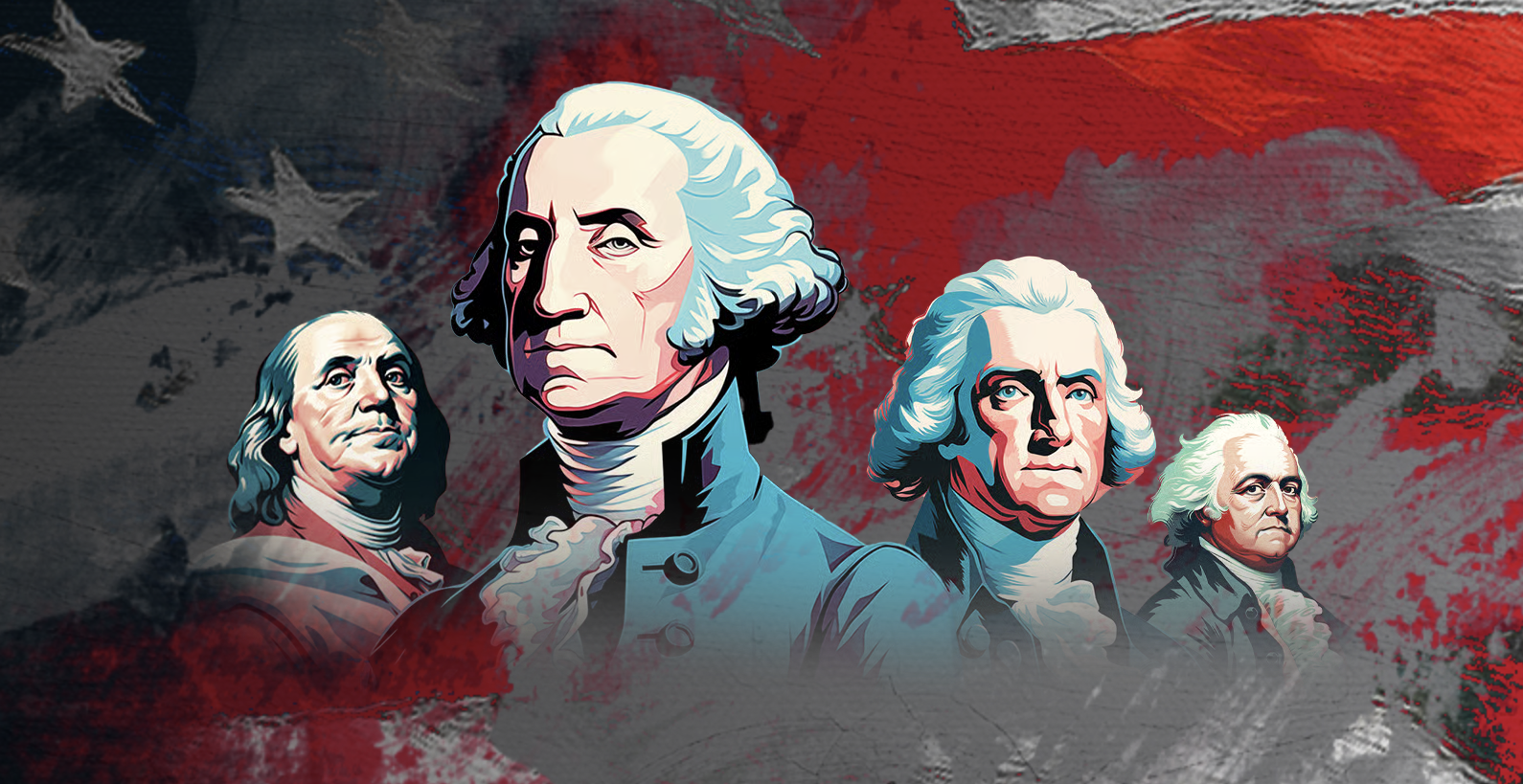
Founding Fathers
This report discusses secularism in the United States through its laws, society and foreign policy from its founding to the present day.
The US Constitution established secularism as a core legal principle primarily through the Establishment and Free Exercise clauses. These texts have not changed, but the laws and precedents based on them have, shaped by the court’s interpretation. Recent decisions, like the abandonment of the Lemon test by the Supreme Court in 2022, have shifted how these constitutional protections have been applied.
Despite the generally secular nature of the legal framework, US society remains deeply religious. A majority of Americans identify as Christian, with White evangelicals in particular making up a vocal and politically active voting bloc, making secularism a divisive partisan issue since the 1970s and 1980s.
Overseas, US support for militant religious groups remains a lawful act under the Constitution but sits uneasily with the requirement of the government to retain neutrality toward religion. Domestically, the political response to the September 11 attacks combined both a message of religious tolerance with the surveillance of Muslim communities and organisations and the use of Christian language in order to foster support for the global war on terror.
Recent executive decisions on secularism have been met with divisiveness along party lines, with some arguing they weaken secularism and some claiming they are strengthening religious freedom. Overall, secularism in the United States has been legally established since its inception, but its scope depends heavily on how it is interpreted and enforced.